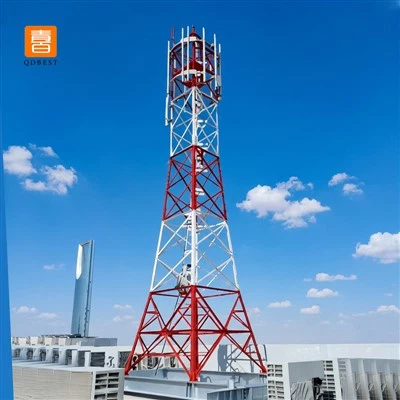
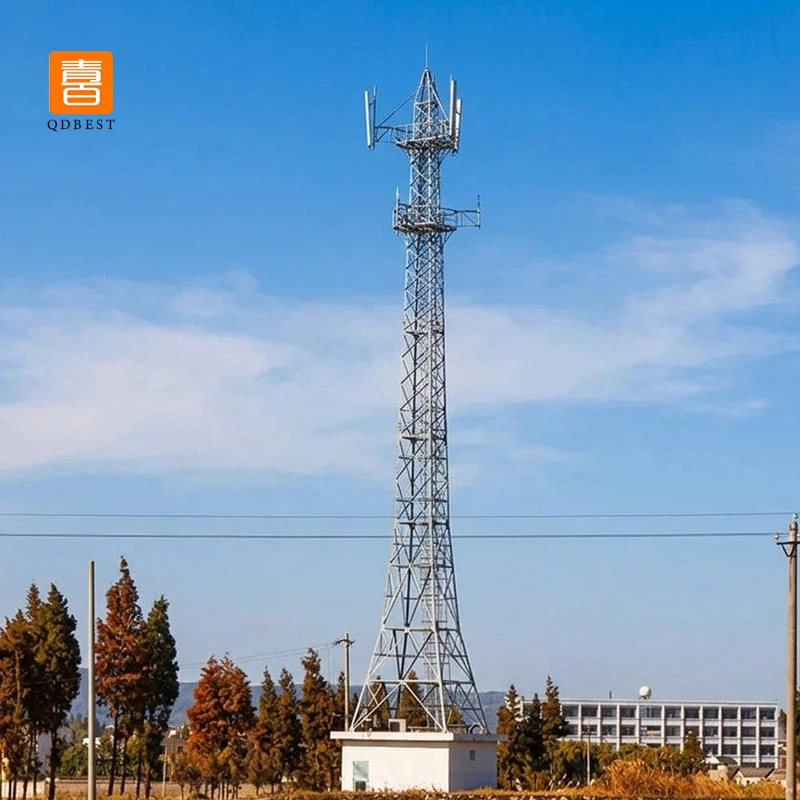
In the modern era of rapid technological advancement, the seamless flow of information is the lifeblood of our interconnected world. Telecom lattice towers stand as silent sentinels in this digital landscape, playing a pivotal role in facilitating communication. As a leading Telecom Lattice Tower supplier, I am well - versed in the intricate ways these towers interact with other communication infrastructure.
1. Interaction with Wireless Base Stations
Wireless base stations are the cornerstone of mobile communication networks. Telecom lattice towers provide a stable and elevated platform for these base stations. The height of the lattice tower allows the base station antennas to have a wider line - of - sight, which is crucial for transmitting and receiving signals over large areas.
The base stations installed on lattice towers are connected to the core network through fiber - optic cables. These cables carry the data traffic between the base stations and the central network, ensuring that calls, texts, and internet data can be routed effectively. For example, in a large urban area, multiple base stations on lattice towers work in tandem to provide continuous coverage. Each base station covers a specific cell area, and the lattice tower's height helps in minimizing signal interference between adjacent cells.
2. Compatibility with Microwave Communication Systems
Microwave communication systems are used for high - speed data transmission over long distances. Telecom lattice towers are ideal for mounting microwave antennas. The lattice structure provides a sturdy support for these antennas, which need to be precisely aligned to ensure efficient signal transfer.
The 25M Galvanized Angle Steel Microwave Communication Tower is a prime example of a tower designed for microwave communication. These towers are engineered to reduce wind resistance and provide a stable environment for the microwave equipment. The microwave signals can be sent between different lattice towers, creating a network of high - speed data links. This is particularly useful in rural or remote areas where laying fiber - optic cables may be difficult or cost - prohibitive.
3. Integration with Satellite Communication
Satellite communication is an important part of the global communication infrastructure. Telecom lattice towers can be used as ground stations for satellite communication. They house the necessary equipment such as satellite dishes and receivers.
The lattice tower's height gives the satellite dish a clear view of the sky, allowing for better reception and transmission of satellite signals. This is especially important for applications like satellite TV, global positioning systems (GPS), and international data communication. For instance, in a remote island, a lattice tower with a satellite dish can provide internet access and communication services to the local population, connecting them to the rest of the world.
4. Collaboration with Fiber - Optic Networks
Fiber - optic networks are the backbone of high - speed data transmission. Telecom lattice towers are often used as points of connection between different fiber - optic segments. The towers can house fiber - optic splice boxes and other equipment that help in routing the optical signals.
The lattice tower's structure also provides a safe and protected environment for the fiber - optic cables. The cables can be run along the tower's framework, reducing the risk of damage from external factors such as weather and human interference. In addition, the height of the tower allows for easy access to the fiber - optic equipment for maintenance and upgrades.
5. Interaction with Small Cell Networks
Small cell networks are becoming increasingly important in urban areas to meet the growing demand for high - speed data. Telecom lattice towers can support small cell base stations. These small cells are used to enhance the coverage and capacity of the existing network in areas with high user density, such as shopping malls, stadiums, and business districts.
The lattice tower can provide power and backhaul connectivity to the small cell base stations. By integrating small cells with lattice towers, operators can optimize the network performance and provide a better user experience. For example, a Roof - top Telecommunication Tower can be used to support small cell base stations on top of buildings, extending the network coverage to the surrounding areas.

6. Impact on 5G and Future Communication Technologies
As the world moves towards 5G and beyond, the role of telecom lattice towers becomes even more critical. 5G technology requires a denser network of base stations to provide high - speed, low - latency communication. Telecom lattice towers can support the deployment of 5G base stations, both macro and small cells.
The lattice tower's design can be optimized to accommodate the new 5G equipment, such as multiple - input multiple - output (MIMO) antennas. These antennas need to be precisely positioned to take advantage of the 5G technology's capabilities. In addition, the towers can be equipped with power - saving features and remote monitoring systems to ensure efficient operation in the 5G era.
7. Considerations for Tower - to - Tower Communication
In a large - scale communication network, tower - to - tower communication is essential. Telecom lattice towers need to be designed to support reliable tower - to - tower links. This involves considerations such as antenna placement, frequency allocation, and signal strength.
The Communication Angle Steel Tower is designed to provide a stable platform for tower - to - tower communication. The tower's structure can be adjusted to optimize the antenna's radiation pattern, ensuring that the signals can be transmitted and received effectively between different towers.
Conclusion
Telecom lattice towers are an integral part of the modern communication infrastructure. They interact with a wide range of other communication systems, from wireless base stations to satellite communication. As a Telecom Lattice Tower supplier, we understand the importance of these interactions and are committed to providing high - quality towers that meet the evolving needs of the communication industry.
If you are in the market for telecom lattice towers or need more information about how our towers can integrate with your existing communication infrastructure, we invite you to reach out for a procurement discussion. Our team of experts is ready to assist you in finding the best solutions for your communication needs.
References
- "Telecommunication Infrastructure Handbook" by John Doe
- "The Future of Wireless Communication" by Jane Smith
- "Tower Design and Installation Guide" by Telecom Industry Association