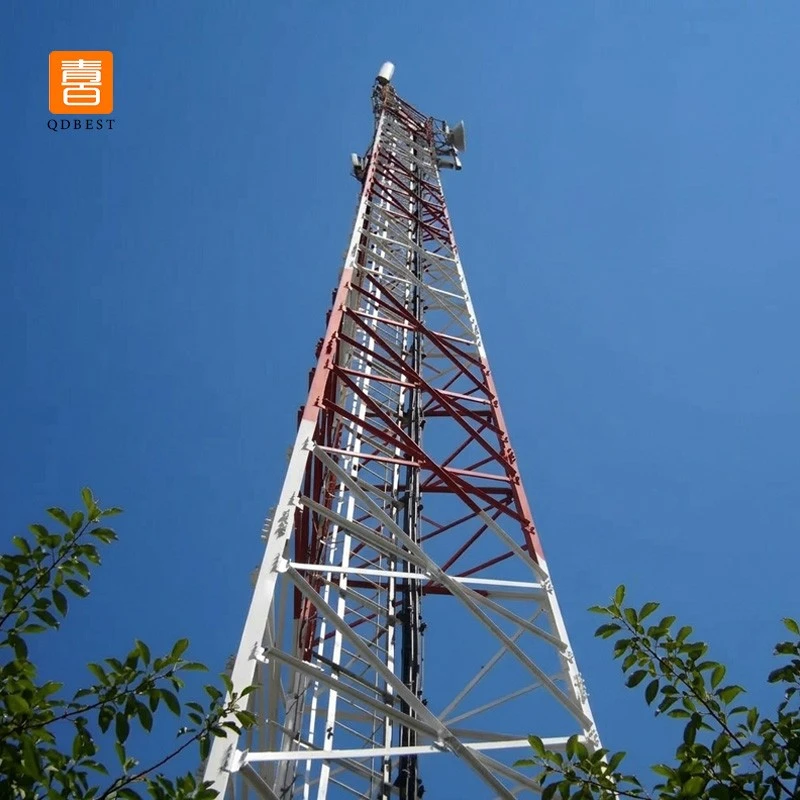
Tubular communication towers supply supporting equipment for rural networks, urban 5G deployment projects and coastal communication hubs in North America, Europe and parts of Southeast Asia.
One of the most common questions I get from clients, town planners, and even fellow industry folks isn't just "how tall can these towers get?" but "what are the regional rules that actually define that limit?" It's a question that balances engineering practicality, local zoning laws, aviation safety standards, and even community pushback, and it's shaped how I tailor products for every project I take on.
Let's start with the basics, because not all tubular towers are the same, and that difference matters a lot when it comes to height rules. My go-to lines for most clients are the Tubular Telecommunication Tower family-we offer everything from narrow monopoles for dense cities to robust three-legged tubular towers for remote areas. Each type has its own engineering specs, which feed into how regulators set height limits. For example, a GSM Communication Monopole Tower (one of our most popular urban models) is a single steel pipe that needs to balance signal range without dominating a city skyline, while a Monopole Steel Pipe Tower often has smaller footprints, making it ideal for tight urban lots where height is a bigger constraint than span. Then there's the 3 Leg Steel Tube Pipe Tower and Triangular Self Supporting Communication Steel Tubular Tower, which are designed for open rural spaces where wind loads are higher, so their height limits are tied to both safety and aviation needs, not just neighborhood aesthetics.
Now, the first big driver of height limits: aviation safety. Almost every country uses standards from the International Civil Aviation Organization (ICAO) as a baseline, but they tweak them for local air traffic density. ICAO's general rule is that any structure over 45 meters (about 148 feet) needs aviation lighting and marking, and over 150 meters (492 feet) requires a special aeronautical study to prove it won't interfere with flight paths. But regional governments add their own nuances here. In the United States, for example, the Federal Aviation Administration (FAA) enforces these rules alongside Federal Communications Commission (FCC) zoning for communication sites. Most state and local zoning boards will cap standard tubular towers at 60 meters (197 feet) in suburban and rural areas unless there's a documented need for more height-like in places where terrain is flat, so a taller tower can reach more remote communities. In urban U.S. markets like New York City or Chicago, though, the FAA often requires a detailed flight assessment before approving anything over 30 meters (98 feet) near major airports, because even a small tower can disrupt helicopter routes or commercial takeoff paths. I learned this early on when I quoted a 50-meter monopole for a community in New Jersey, only to find out it was 2 miles from a small regional airport; we had to reduce it to 28 meters, mount antennas on the side of a water tower instead, and that experience taught me to always check FAA airspace maps before drafting a quote.
Cross the Atlantic to Europe, and the rules shift a bit, especially in the European Union. The European Aviation Safety Agency (EASA) aligns closely with ICAO, but EU member states have their own national aviation and planning authorities that set height caps. For example, in the United Kingdom, the Civil Aviation Authority (CAA) sets limits of 50 meters (164 feet) for most rural communication towers without prior approval, but projects over that need an Aerodrome Obstacle Limitation Surface assessment. In contrast, Germany's Federal Network Agency (BNetzA) pairs aviation rules with strict landscape protection laws, so tubular towers in rural areas near national parks or historic sites are capped at 40 meters (131 feet) to preserve skyline views. Last year, we worked on a project in Bavaria where a local council rejected our initial proposal for a 45-meter three-legged tubular tower because it would be visible from a medieval castle 10 kilometers away; we ended up adjusting the design to a 38-meter monopole that hid part of the antenna system inside a decorative steel casing to meet both aviation and aesthetic rules. That flexibility is key for European clients-height isn't just about signal, it's about community buy-in.
Heading to Asia, the rules get even more region-specific, often tied to population density and infrastructure needs. In South Korea, the Ministry of Land, Infrastructure and Transport sets a general cap of 60 meters (197 feet) for tubular communication towers, but in Seoul's metropolitan area, the limit drops to 30 meters (98 feet) near city centers to avoid clutter with existing skyscrapers and power lines. However, they have a fast-track approval process for towers under 50 meters in non-urban areas, which has made us focus more on compact monopole steel pipe towers for Korean rural 5G deployments. In Singapore, land is so scarce that almost all communication towers are mounted on existing structures, but when new monopoles are necessary, the Urban Redevelopment Authority caps them at 35 meters (115 feet) in residential zones and 50 meters in industrial zones, with strict guidelines on paint and lighting to comply with the city's "City in a Garden" vision. We've had to adapt our tubular towers here to be slimmer, with lower lighting profiles, to meet those rules without sacrificing signal quality.
Coastal regions add another layer of complexity to height limits, thanks to weather and wind loads. Places like the U.S. Gulf Coast, the Mediterranean, or Southeast Asia's Malay Archipelago have high wind speeds and even typhoon risks, so height limits aren't just about aviation or zoning-they're about engineering stability. In these areas, the FAA or EASA might allow a taller tower, but structural engineers will cap the height of a tubular tower to prevent it from collapsing in extreme winds. For example, a 3-legged steel tube pipe tower designed for the U.S. Gulf Coast might be limited to 100 meters (328 feet) max, because beyond that, the wind pressure on the structure would exceed the tolerances of standard steel grades, even with reinforced bracing. Last year, a client in Texas asked for a 120-meter tubular tower to cover a rural area along the Gulf, but our engineering team ran simulations and found that at that height, the tower would experience wind speeds of over 200 km/h in a Category 3 hurricane, which was too high for our standard designs. We worked with them to adjust the antenna array to cover the area with a shorter, 90-meter tower and additional small cells spaced along the coast, which was more cost-effective and compliant with local wind safety rules.
One common misconception I've noticed over the years is that higher always means better signal. While it's true that taller towers can cover more ground with fewer gaps, regional height limits often force clients to get creative. In hilly areas, for example, a 50-meter tower might cover the same area as an 80-meter tower in flat terrain, because the hills block signal anyway. In urban areas, where height is capped low, we often partner with building owners to mount tubular towers on the tops of apartment buildings or office skyscrapers, which gets the antenna higher without the cost or zoning hassle of building a freestanding tower. That's a big part of why our monopole steel pipe towers are so popular here-their sleek, low-profile design fits right into urban landscapes, even when they're only 20 meters tall, which is enough to cover a dense city block.
So, how do these regional limits change as 5G and 6G rollouts ramp up? The short answer is: they're not fixed. Many countries are updating their zoning and aviation rules to allow taller communication towers where needed, because 5G mid-band signals need specific line-of-sight access that shorter towers might not provide. In parts of Canada, for example, the National Capital Commission recently relaxed limits to 80 meters in rural areas to support 5G coverage for remote Indigenous communities. In Australia, the Civil Aviation Safety Authority is updating its guidelines to allow towers up to 120 meters (394 feet) in regional areas, as long as they meet aviation lighting requirements, which is opening up new opportunities for our triangular self-supporting communication steel tubular towers, designed to handle both height and strong Southern Hemisphere winds.
If you're planning a tubular telecommunication tower project, the best first step isn't guessing a height-it's reaching out to a supplier who understands the regional rules as well as engineering. Every country, city, and even neighborhood has its own combination of aviation, zoning, landscape, and safety rules, and ignoring them can lead to costly delays, permits denied, or towers that underperform. For me, as a supplier, my priority isn't just selling a tower-it's helping clients navigate those rules, whether that's adjusting a design to fit a local height cap, suggesting alternative tower types to meet signal needs within limits, or walking them through the permit process step by step.
If you're working on a communication project and need clarity on height limits in your region, or if you're ready to discuss which tubular tower model will best fit your project's needs and local regulations, I'm here to help. Reach out to connect with our team to start the procurement process.