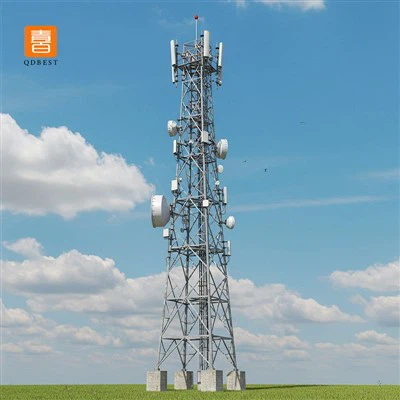
This blog post discusses the signal coverage range of tubular communication towers.
Understanding the Basics
First off, what exactly is a tubular telecommunication tower? Well, it's a type of tower designed to support various telecommunication equipment like antennas. You can check out more about Tubular Telecommunication Tower on our website. These towers come in different shapes and sizes, and they play a crucial role in the world of wireless communication.
Factors Affecting Signal Coverage
There are several factors that determine the signal coverage area of a tubular telecommunication tower. Let's take a look at some of the most important ones.
Tower Height
One of the most significant factors is the height of the tower. Generally speaking, the taller the tower, the larger the coverage area. This is because a higher tower can transmit signals over a greater distance without being obstructed by buildings, trees, or other obstacles. For example, a tower that's 100 meters tall will have a larger coverage area than a tower that's only 50 meters tall.
Antenna Type and Placement
The type of antenna used on the tower also plays a big role in signal coverage. Different antennas have different radiation patterns, which can affect how far and in what direction the signals are sent. For instance, a directional antenna can focus the signal in a specific direction, providing better coverage in that area. Additionally, the placement of the antenna on the tower is crucial. It needs to be positioned in a way that maximizes the signal strength and coverage.
Frequency of the Signal
The frequency of the signal being transmitted also impacts the coverage area. Higher frequency signals tend to have a shorter range compared to lower frequency signals. This is because higher frequency signals are more easily absorbed by obstacles and have a harder time traveling long distances. So, if you're looking for a wider coverage area, you might want to consider using a lower frequency signal.
Environmental Conditions
The environment around the tower can also affect signal coverage. For example, areas with a lot of buildings, mountains, or dense vegetation can obstruct the signals and reduce the coverage area. On the other hand, open areas with few obstacles will generally have better signal coverage. Weather conditions can also play a role. Rain, snow, and fog can all absorb or scatter the signals, leading to a decrease in coverage.
Calculating the Signal Coverage Area
Calculating the exact signal coverage area of a tubular telecommunication tower can be a complex task. It involves taking into account all the factors we mentioned above, as well as using specialized software and mathematical models. However, there are some general guidelines that can give you an idea of the coverage area.
One common method is to use the line-of-sight (LOS) principle. This principle assumes that the signal travels in a straight line from the antenna to the receiver. Based on the height of the tower and the curvature of the Earth, you can calculate the maximum distance that the signal can travel before it is blocked by the horizon. This gives you an estimate of the coverage area in a circular pattern around the tower.
Another approach is to use empirical data and field tests. By measuring the signal strength at different locations around the tower, you can map out the coverage area and identify any areas with weak or no signal. This can help you optimize the tower's design and placement to improve the coverage.
Our Tower Offerings
At our company, we offer a variety of tubular telecommunication towers to meet different needs. For example, our Galvanized Outdoor Steel Wifi Tower is a great option for providing wireless internet coverage in outdoor areas. It's made of high-quality steel and is designed to withstand harsh weather conditions.
We also have the Triangular Self Supporting Communication Steel Tubular Tower, which is a self-supporting tower that offers excellent stability and durability. This tower is suitable for a wide range of telecommunication applications, including cellular networks, radio stations, and more.
Contact Us for Purchasing
If you're interested in purchasing a tubular telecommunication tower, we'd love to hear from you. Our team of experts can help you choose the right tower for your specific needs and provide you with a detailed quote. Whether you're looking for a small tower for a local area or a large tower for a wide coverage area, we have the solutions you need.


So, don't hesitate to reach out and start a conversation with us. We're here to help you take your telecommunication network to the next level.