Telecommunication towers are like the unsung heroes of our digital world. They're the tall structures you see dotting the landscape, making sure that our phones, tablets, and other devices can connect to the internet and make calls. But how do they actually do that? Well, it all boils down to communication protocols.
1. GSM (Global System for Mobile Communications)
GSM is one of the most well - known communication protocols out there. It's been around for ages, and it laid the foundation for modern mobile communication. When you're using your old - school flip phone or even some basic smartphones, chances are GSM is at work behind the scenes.
GSM operates in different frequency bands, typically around 900 MHz and 1800 MHz in Europe and other parts of the world, and 850 MHz and 1900 MHz in the United States. Our 60M Angle Steel Gsm Microwave Telecom Tower is specifically designed to handle GSM signals efficiently. It provides a stable platform for the antennas that transmit and receive these signals, ensuring that your calls are clear and your data transfer is smooth.
One of the great things about GSM is its security features. It uses encryption to protect your calls and data from eavesdropping. It also has a standardized way of handling subscriber information, which makes it easy for mobile network operators to manage their customers.
2. CDMA (Code - Division Multiple Access)
CDMA is another important protocol in the telecom world. Unlike GSM, which uses time - division to separate different users' signals, CDMA uses unique codes. Each user is assigned a specific code, and the signals are transmitted simultaneously over the same frequency band.
This approach has some advantages. CDMA can handle more users in a given area, and it generally provides better call quality, especially in areas with high traffic. Our Communication Angle Steel Tower is built to support CDMA technology. The tower's design allows for optimal signal propagation and reception, which is crucial for CDMA networks to function at their best.
However, CDMA also has its limitations. It can be more complex to implement compared to GSM, and it requires more sophisticated equipment. But for large - scale networks that need to handle a high volume of users, CDMA is a great option.


3. LTE (Long - Term Evolution)
LTE is what most of us are using today. It's the fourth - generation (4G) mobile communication standard that offers super - fast data speeds. With LTE, you can stream high - definition videos, play online games, and download large files in no time.
LTE uses a combination of orthogonal frequency - division multiplexing (OFDM) and multiple - input multiple - output (MIMO) technologies. OFDM divides the available frequency spectrum into multiple sub - carriers, which allows for more efficient data transmission. MIMO, on the other hand, uses multiple antennas at both the transmitter and the receiver to improve the signal quality and increase the data rate.
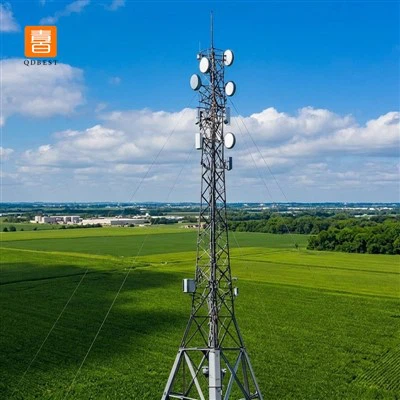
Our Telecom Lattice Tower is well - equipped to support LTE networks. The tower's structure provides a stable base for the multiple antennas required for MIMO technology. And its height ensures that the signals can cover a large area, which is essential for providing widespread LTE coverage.
4. 5G NR (New Radio)
The future is here, and it's 5G! 5G NR is the next big thing in mobile communication. It promises even faster data speeds, lower latency, and the ability to connect a massive number of devices simultaneously.
5G operates in different frequency bands, including millimeter - wave (mmWave) frequencies. These high - frequency bands offer a huge amount of bandwidth, but they also have a shorter range and are more easily blocked by obstacles. That's where our 25M Galvanized Angle Steel Microwave Communication Tower comes in. Its height and design are optimized to overcome the challenges of mmWave frequencies, allowing for better signal propagation and coverage.
5G also uses advanced technologies like beamforming, which focuses the signal in a specific direction to improve the signal strength and quality. And with its ultra - low latency, 5G is not only great for consumer devices but also for applications like autonomous vehicles, smart cities, and industrial automation.
5. WiMAX (Worldwide Interoperability for Microwave Access)
WiMAX is a wireless communication protocol that provides broadband access over a wide area. It's similar to Wi - Fi but can cover much larger distances. WiMAX uses orthogonal frequency - division multiple access (OFDMA) to transmit data, which is similar to the technology used in LTE.
Our 4 - Legged Tubular Lattice Cell Steel Tower is a great choice for WiMAX networks. The tubular design of the tower provides excellent strength and stability, and it can support the large antennas required for WiMAX transmission.
WiMAX was once seen as a competitor to LTE, but it hasn't gained as much widespread adoption. However, it still has its uses in certain areas, especially in rural or remote locations where traditional wired broadband is not available.
The Importance of Choosing the Right Tower for the Protocol
As you can see, different communication protocols have different requirements. That's why it's crucial to choose the right telecommunication tower for the specific protocol you're using. A well - designed tower can improve the performance of the network, reduce interference, and increase the coverage area.
We, as a telecommunication tower supplier, understand the importance of this. Our towers are engineered with the latest technology and highest quality materials to ensure that they can support a wide range of communication protocols. Whether you're looking to build a GSM network, an LTE network, or even a 5G network, we have the right tower for you.
Let's Talk Business!
If you're in the market for a telecommunication tower, or if you have any questions about which tower is best for your specific communication protocol, I'd love to chat. We can work together to find the perfect solution for your needs. Whether you're a small - scale operator or a large - scale telecom company, we're here to help you take your network to the next level.