Executive Summary & Core Specifications
A Monopole Tower is a self-supporting steel structure built around a single tapered shaft, engineered specifically for telecommunications and wireless infrastructure. Unlike multi-leg lattice frames or guyed masts, a monopole provides structural load-bearing capacity with a remarkably compact footprint, making it ideal for space-constrained or urban environments.
Structure Type: Self-supporting single-shaft steel tower
Shaft Configuration: Tapered polygonal (hexagonal/octagonal) or circular tubular steel sections
Installation: Ground-mounted, custom-engineered for site-specific civil works
Primary Applications: Cellular networks (4G/5G), rural wireless coverage, urban infrastructure, and transport corridor monitoring
Antenna Support: Sector antennas, panel antennas, microwave dishes, and remote radio units (RRUs)
Connection System: Flanged high-strength bolted field connections
Corrosion Protection: Hot-dip galvanizing (HDG) per international standards, with optional multi-layer paint systems
Key Design Inputs: Structural height, design wind speed, topographic exposure, equipment projected wind area (EPA), ice loading, and allowable deflection limits
-
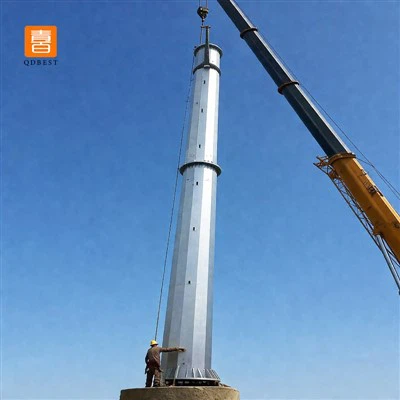
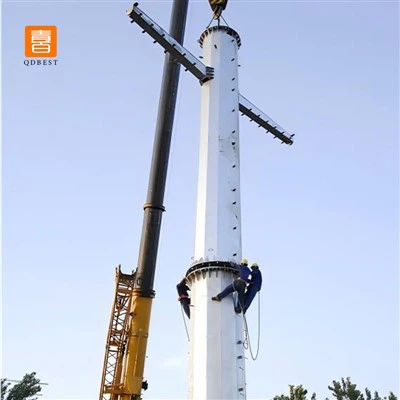
![Hot Dip Galvanized Single Tube Steel Pipe Tower]() Hot Dip Galvanized Single Tube Steel Pipe Tower
Hot Dip Galvanized Single Tube Steel Pipe TowerTower Type: Hot Dip Galvanized Single Tube Steel Pipe Tower
Country of origin: China
Manufacturer: Qingdao BEST Steel Structure Co., Ltd.
Material: carbon steel Q235 Q355 Q420... -
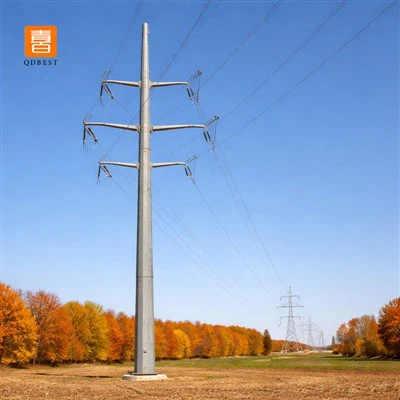
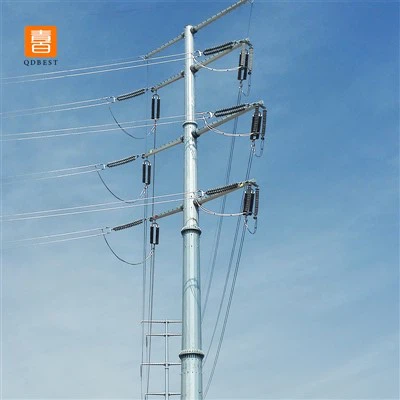
![Transmission Tower Pole Outdoor Monopole Tower]() Transmission Tower Pole Outdoor Monopole Tower
Transmission Tower Pole Outdoor Monopole TowerTower Type: Transmission Tower Pole Outdoor Monopole Tower
Country of origin: China
Manufacturer: Qingdao BEST Steel Structure Co., Ltd.
Material: carbon steel Q235 Q355 Q420... -
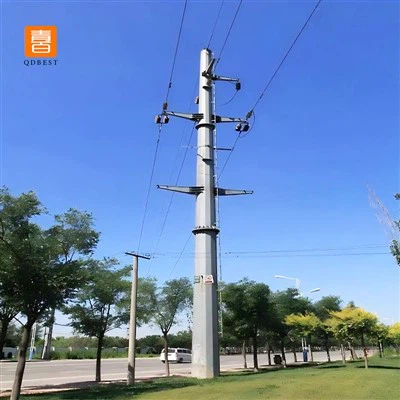
![33kV Galvanized Iron Steel Monopole Tower]() 33kV Galvanized Iron Steel Monopole Tower
33kV Galvanized Iron Steel Monopole TowerTower Type: 33kV Galvanized Iron Steel Monopole Tower
Country of origin: China
Manufacturer: Qingdao BEST Steel Structure Co., Ltd.
Material: carbon steel Q235 Q355 Q420... -
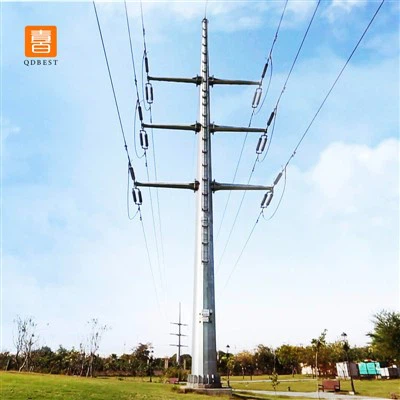
![Galvanized Steel Monopole Towers For Transmission Lines]() Galvanized Steel Monopole Towers For Transmission Lines
Galvanized Steel Monopole Towers For Transmission LinesTower Type: Galvanized Steel Monopole Towers for Transmission Lines
Country of origin: China
Manufacturer: Qingdao BEST Steel Structure Co., Ltd.
Material: carbon steel Q235... -
![Monopole Tower For Transmission Line]() Monopole Tower For Transmission Line
Monopole Tower For Transmission LineTower Type: Monopole Tower for Transmission Line
Country of origin: China
Manufacturer: Qingdao BEST Steel Structure Co., Ltd.
Material: carbon steel Q235 Q355 Q420... -
![Monopole Galvanized Steel Power Transmission Tower]() Monopole Galvanized Steel Power Transmission Tower
Monopole Galvanized Steel Power Transmission TowerTower Type: Monopole Galvanized Steel Power Transmission Tower
Country of origin: China
Manufacturer: Qingdao BEST Steel Structure Co., Ltd.
Material: carbon steel Q235 Q355...


Monopole Tower Configurations
Tapered Polygonal Monopoles
Fabricated from high-grade steel plates bent and welded into multi-sided tapered sections. This configuration offers high structural efficiency, excellent torsional resistance, and easy transportability via slip-joint or flanged field splices.
Tubular (Circular) Monopoles
Manufactured from seamless or rolled round steel pipes, preferred where uniform wind-shedding characteristics or architectural aesthetics dictate a smooth, round profile.
Multi-Section Modular Monopoles
Tall towers are segmented into transportable sections to accommodate shipping constraints and crane capacities. Splice joint design (slip-sleeve or bolted flanges) is critical for maintaining structural continuity under bending moments.

Essential Technical Parameters for Procurement
A comprehensive Request for Quotation (RFQ) must establish the following design criteria to ensure structural safety and compliance:
Tower Height Definitions: Explicitly specify pole height, antenna centerline, and total overall height above finished ground level.
Wind Design Criteria: Basic wind speed, exposure category (B, C, or D), importance factor, topographic effects, and applicable design codes (e.g., TIA-222 or Eurocode).
Equipment Loading Schedule: Detailed breakdown of antenna counts, model dimensions, weight, exact mounting elevations, orientation angles, and coaxial/fiber cable quantities.
Allowable Deflection & Rotation: Twist and sway limits (typically less than or equal to 0.5 to 1.0 degrees under design wind) to prevent signal degradation for directional and microwave links.
Material Specifications: Steel grades (e.g., ASTM A572 Grade 50 / S355), minimum yield strengths, and certified mill test reports.
Foundation Interface: Base plate geometry, anchor bolt cage specifications, stiffener details, and reaction forces (overturning moment, shear, and axial loads) for geotechnical design.
Surface Treatment: Hot-dip galvanizing compliance (e.g., ASTM A123 / ISO 1461) specifying minimum coating thickness and post-treatment passivation.
Manufacturing Process & Quality Control
To guarantee long-term structural integrity, the production workflow follows strict quality assurance milestones:
Engineering Review & Finite Element Analysis (FEA): Validating load cases and shop drawing approval prior to material release.
Raw Material Inspection: Verifying steel plates and flanges against mill test certificates.
CNC Cutting & Bending: Precision plasma/laser cutting and hydraulic press-braking to form tapered polygonal shells.
Automated Longitudinal Welding: Utilizing submerged arc welding (SAW) or gas metal arc welding (GMAW) under certified welding procedures (WPS/WPQR).
Flange & Bracket Integration: Welding base flanges, splice rings, climbing ladder brackets, and antenna collar mounts.
Hot-Dip Galvanizing: Complete immersion in molten zinc baths to ensure total internal and external corrosion defense.
Pre-Assembly & Dimensional Check: Trial fitting sections to verify bolt-hole alignment, straightness, and flange mating tolerance.
Comprehensive RFQ Submission Checklist
When reaching out to manufacturers, including these items accelerates technical review and accurate pricing:
Project Location & Environment:
Wind zone, seismic zone, and corrosive environment indicators.
Loading Schedule:
Complete antenna and microwave inventory with weight and wind-load area.
Design Standards:
Preferred code framework (TIA-222-H, Eurocode, or local national standards).
Documentation Requirements:
Certified structural calculations, shop drawings, third-party inspection (TPI) provisions, and material traceability records.
FAQ
Qingdao BEST Steel Structure Co., Ltd. is one of the most professional the monopole tower manufacturers and suppliers in China. We warmly welcome you to buy customized the monopole tower made in China here from our factory. If you have any enquiry about OEM service, please feel free to email us.