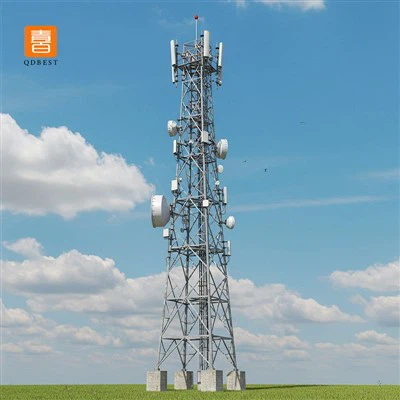
Numerous clients have enquired whether lattice tower frames can be deployed for meteorological observation. This blog post provides a comprehensive overview of relevant information, explaining the suitability of such structures for weather monitoring, their respective advantages and disadvantages, as well as several real-world application cases.
First off, let's get a quick understanding of what lattice towers are. We offer a bunch of different types, like the 4 - Legged Angular Electric Transposition Lines Steel Tower, Transmission Structures, Lattice Steel Tower, High Voltage Tower, and Four Legged Angle Steel Tower. They're typically made of steel, with a framework of connected pieces that form a lattice pattern. This design gives them strength while keeping the weight relatively low, which is super useful for a whole bunch of applications.
Now, let's dig into whether they can be used for meteorological observations. The short answer is yes! And here's why. One of the key requirements for meteorological observations is to get accurate data from different heights. Lattice towers are perfect for this because they can be built tall, reaching up into the sky to access different atmospheric layers. For example, we can install anemometers on the tower to measure wind speed and direction at various levels. This is crucial for understanding how wind changes with altitude, which can help in weather forecasting and even in the planning of wind farms.
Temperature and humidity sensors can also be placed on lattice towers. By having multiple sensors at different heights, meteorologists can study the vertical temperature and humidity profiles in the atmosphere. This data is invaluable for predicting weather patterns, such as the formation of clouds and precipitation.
Another advantage is that lattice towers are sturdy. They can withstand harsh weather conditions like strong winds, heavy rain, and even snow. This means that the meteorological instruments installed on them are less likely to be damaged during extreme weather events. So, you can count on getting consistent data over time.


There are also cost - effective benefits. Building a special tower just for meteorological observations can be pretty pricey. But lattice towers, which are commonly used for other purposes like electricity transmission, can be easily adapted for meteorological use. You don't have to spend a fortune on building a brand - new structure from scratch.
However, it's not all sunshine and rainbows. There are some drawbacks to using lattice towers for meteorological observations. One of the main issues is the potential for interference. The structure of the lattice tower can disrupt the flow of air around it, which can affect the accuracy of wind measurements. For instance, if the wind gets blocked or redirected by the tower's framework, the anemometers might give inaccurate readings.
Also, the metal in the lattice tower can conduct heat. This can cause temperature sensors placed close to the tower to give false readings, as the metal might absorb or radiate heat in a way that doesn't represent the actual atmospheric temperature.
In real - world scenarios, many meteorological stations around the world have successfully used lattice towers for their observations. In some rural areas, existing electricity transmission lattice towers have been modified to include meteorological instruments. This has allowed local meteorological departments to gather data without having to invest a large amount of money in new infrastructure.
In the field of research, lattice towers have also played an important role. Scientists studying the atmosphere in remote locations often rely on these towers to install their equipment. They can set up long - term monitoring stations on lattice towers, collecting data over months or even years to understand climate change and weather patterns in those areas.
So, if you're in the meteorological field and thinking about using lattice towers for your observations, it's definitely worth considering. But you need to be aware of the potential issues and take steps to minimize them. For example, you can carefully choose the location of the instruments on the tower to reduce interference. You can also use shielding or insulation for temperature sensors to prevent heat conduction from the tower.
As a lattice tower supplier, I've seen firsthand how these towers can be adapted for various uses, including meteorological observations. We have a wide range of lattice towers that can be customized to meet your specific needs. Whether you need a small tower for a local weather station or a large one for a research project, we've got you covered.
If you're interested in learning more about our lattice towers or want to discuss how they can be used for your meteorological observations, don't hesitate to reach out. We're here to help you find the best solution for your requirements.