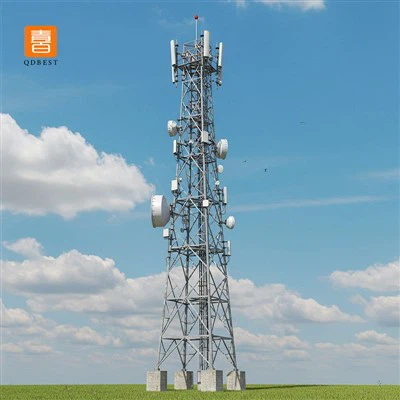
Wind-induced vibration is a critical concern for lattice towers, which are widely adopted in power transmission, telecommunications and other industries. Implementing effective vibration reduction measures is essential to guarantee the structural integrity and long-term service performance of tower structures. This paper introduces various suppression solutions for wind-induced vibration applicable to lattice towers.
Understanding Wind-Induced Vibration
Wind-induced vibration occurs when the wind flow around a lattice tower causes dynamic forces that can lead to oscillations. These oscillations can be classified into two main types: vortex-induced vibration (VIV) and galloping. Vortex-induced vibration is caused by the shedding of vortices from the tower members, which creates alternating forces that can excite the tower's natural frequencies. Galloping, on the other hand, is a self-excited vibration that occurs when the wind flow interacts with the tower's cross-section in a way that causes large-amplitude oscillations.
The effects of wind-induced vibration can be detrimental to the lattice tower. Excessive vibrations can lead to fatigue damage, which can reduce the tower's service life and increase the risk of structural failure. In addition, vibrations can also cause discomfort to nearby residents and interfere with the normal operation of equipment installed on the tower.
Mitigation Measures
Aerodynamic Modifications
One of the most effective ways to mitigate wind-induced vibration is through aerodynamic modifications. These modifications aim to reduce the wind forces acting on the tower by changing its shape or surface characteristics.
- Streamlined Shapes: Designing the tower members with streamlined shapes can reduce the drag coefficient and the likelihood of vortex shedding. For example, using circular or elliptical cross-sections instead of square or rectangular ones can significantly reduce the wind-induced forces.
- Fairings: Installing fairings on the tower members can also help to reduce the wind forces. Fairings are aerodynamic devices that are attached to the tower members to change the flow pattern around them. They can be made of various materials, such as fiberglass or aluminum, and can be designed to fit different tower configurations.
- Surface Roughness: Increasing the surface roughness of the tower members can also reduce the wind-induced forces. This can be achieved by using materials with a rough surface finish or by adding surface treatments, such as sandblasting or coating.
Structural Damping
Structural damping is another important mitigation measure for wind-induced vibration. Damping is the ability of a structure to dissipate energy when it is subjected to dynamic loads. By increasing the damping of the lattice tower, the amplitude of the vibrations can be reduced.
- Tuned Mass Dampers (TMDs): TMDs are passive devices that are designed to absorb and dissipate the energy of the vibrations. They consist of a mass, a spring, and a damper, and are tuned to the natural frequency of the tower. When the tower vibrates, the TMD oscillates out of phase with the tower, which reduces the amplitude of the vibrations.
- Viscoelastic Dampers: Viscoelastic dampers are another type of passive damping device. They are made of a viscoelastic material, such as rubber or silicone, which has the ability to absorb and dissipate energy when it is deformed. Viscoelastic dampers can be installed on the tower members to reduce the wind-induced vibrations.
- Fluid Viscous Dampers: Fluid viscous dampers are active damping devices that use a fluid to dissipate the energy of the vibrations. They consist of a piston and a cylinder filled with a viscous fluid, and are designed to provide a damping force that is proportional to the velocity of the vibrations. Fluid viscous dampers can be installed on the tower to reduce the wind-induced vibrations.
Structural Stiffening
Structural stiffening is a measure that can be used to increase the stiffness of the lattice tower and reduce the amplitude of the vibrations. This can be achieved by adding additional members or by increasing the size of the existing members.
- Bracing: Adding bracing to the lattice tower can increase its stiffness and reduce the wind-induced vibrations. Bracing can be installed in different configurations, such as diagonal bracing or cross bracing, depending on the tower's design and the wind conditions.
- Increasing Member Size: Increasing the size of the tower members can also increase the stiffness of the tower and reduce the wind-induced vibrations. This can be achieved by using larger cross-sections or by increasing the thickness of the members.
Monitoring and Control
Monitoring and control are important aspects of wind-induced vibration mitigation. By monitoring the vibrations of the lattice tower, it is possible to detect any changes in the vibration characteristics and take appropriate measures to prevent structural damage.
- Vibration Sensors: Installing vibration sensors on the lattice tower can provide real-time information about the vibrations. These sensors can measure the amplitude, frequency, and direction of the vibrations, and can be used to detect any abnormal vibrations.
- Control Systems: Control systems can be used to adjust the damping or stiffness of the tower in response to the vibrations. For example, a control system can be used to activate the TMDs or the fluid viscous dampers when the vibrations exceed a certain threshold.
Our Products and Services
As a lattice tower supplier, we offer a wide range of products and services to meet the needs of our customers. Our lattice towers are designed and manufactured to meet the highest standards of quality and safety, and are available in various configurations and sizes.
- 330kV Electric Transmission Line Tower: Our 330kV Electric Transmission Line Tower is designed to transmit high-voltage electricity over long distances. It is made of high-strength steel and is designed to withstand the harsh environmental conditions.
- Angle Steel Transmission Towers: Our Angle Steel Transmission Towers are made of angle steel and are widely used in power transmission and communication applications. They are available in various configurations and sizes, and can be customized to meet the specific requirements of our customers.
- 110kV - 750kV Transmission Line Tower: Our 110kV - 750kV Transmission Line Tower is designed to transmit high-voltage electricity over long distances. It is made of high-strength steel and is designed to withstand the harsh environmental conditions.
In addition to our products, we also offer a range of services, including design, engineering, manufacturing, installation, and maintenance. Our team of experienced engineers and technicians can provide customized solutions to meet the specific needs of our customers.


Contact Us for Procurement
If you are interested in purchasing lattice towers or need more information about our products and services, please contact us. We are committed to providing high-quality products and services at competitive prices, and we look forward to working with you.