If you've ever driven past a major highway at rush hour, you've probably felt the faint hum of vibration in your car's steering wheel. What you might not realize is that that same vibration can reach structures miles away-including the four-legged lattice towers that crisscross our landscapes as critical nodes for telecom, power, and broadcast infrastructure. Today, I want to break down how traffic vibration impacts these towers, what that means for design and maintenance, and why choosing the right lattice tower for your location makes all the difference.
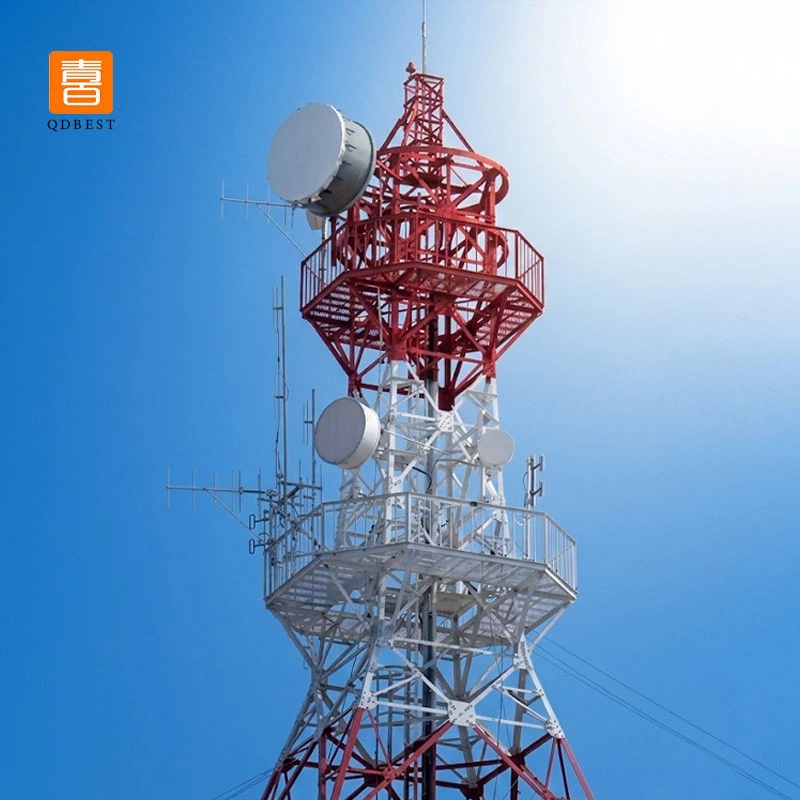
First, let's ground ourselves in what a four-legged lattice tower is. Unlike solid monolithic structures, four-legged lattice towers are built with angular steel members arranged in a grid pattern, which makes them lightweight yet incredibly strong for their height. They're commonly used for telecom networks, power transmission, and even wind measurement, with variations tailored to different environments. You might recognize them from highway interchanges, rural hilltops, or even city rooftops. For context, some of our most popular models include the 35M Telecom 4-Legged Galvanized Angular Steel Towers, built specifically to balance height requirements with wind and seismic resistance, and the Telecom Lattice Tower line, designed to minimize visual impact while maintaining structural integrity.
Traffic-generated vibration is a complex force, not just a single "shake." When heavy trucks pass over a roadway, they create two primary types of vibration: ground-borne (seismic) vibration and air-borne vibration. Ground-borne vibration travels through the soil, while air-borne vibration moves through the atmosphere and can act directly on the tower's legs and cross-members. The frequency and amplitude of this vibration depend on several factors: vehicle weight, speed, the condition of the road surface, and the distance between the traffic and the tower. A fully loaded 18-wheeler driving at 60 mph on a poorly maintained road, for example, creates more vibration than a small car on a smooth highway, and that vibration weakens as it travels further from the source.
Now, how does this translate to effects on a four-legged lattice tower? Let's start with the immediate, tangible impacts. For towers located within 50 meters of a major highway, repeated traffic vibration can cause two main issues: fatigue in steel members and displacement of the tower's foundation. Fatigue occurs when cyclic stress from vibration exceeds the steel's endurance limit over time. Even though each individual vibration event is small, thousands of these events every day add up. For lattice towers, which rely on bolted connections between steel members, this cyclic stress can loosen bolts over time, creating gaps that amplify future vibration. Over years, this can lead to cracks in the steel itself, especially at joints where stress is concentrated.
Foundation displacement is another critical concern. Four-legged lattice towers transfer their weight and any additional loads (like antennas or power lines) to the ground through their four legs, which are anchored in concrete footings. Traffic vibration can loosen the soil around these footings, particularly in areas with loose or sandy soil. This doesn't just shift the tower slightly; even a small tilt of 1-2 degrees can throw off the alignment of antenna arrays, which are calibrated to work within a specific angular range. For telecom towers, this can reduce signal strength or cause intermittent outages that are hard to trace.
But it's not all negative-there are factors that can mitigate these effects, starting with how the tower is designed. For example, the angular steel structure of four-legged towers inherently has more flexibility than solid towers, which actually helps absorb vibration rather than transferring it directly. This is why we prioritize galvanized steel in our models like the 25M Galvanized Angle Steel Microwave Communication Tower; galvanization adds a protective layer that resists corrosion, which would otherwise weaken steel members and make them more susceptible to fatigue from vibration. Corrosion is a silent accelerant-if a steel member is rusted, its strength drops, and traffic vibration can cause it to fail much faster than an uncorroded one.
Location also plays a huge role. A tower built on a solid rock foundation, far less likely to shift, will fare better than one in soft soil near a busy highway. That's why when we work with clients, we first assess the proximity to traffic and the soil conditions before recommending a model. For rooftops, like our A Roof-top Telecommunication Tower, the foundation is often the building's structure itself, which is stiffer and more stable than ground-level footings-so traffic vibration (from street-level traffic below the rooftop) has a far smaller impact. Rooftop towers also benefit from their height, as traffic vibration dissipates before it reaches the upper levels of the building.
Another key point is frequency resonance. Every structure has a natural frequency at which it vibrates most easily. If traffic vibration matches this natural frequency, the tower can enter a state of resonance, which amplifies the vibration to dangerous levels. For four-legged lattice towers, which have a natural frequency typically between 1 and 5 Hz, heavy trucks can generate vibration in this range, especially when they're driving at a consistent speed over a rough road. To avoid this, engineers adjust the tower's design-by adding or removing cross-members, changing the size of steel members, or adjusting the foundation-to shift its natural frequency away from common traffic vibration frequencies. This is a critical step in our design process, and it's why our communication angle steel tower models are engineered for specific local traffic patterns, not just generic standards.
I want to share a real-world example from a project we completed a few years ago. A telecom company in Ohio contacted us because their 30-meter four-legged tower, located just 30 meters from a major interstate, was experiencing intermittent signal outages. They'd already checked their antennas, cables, and power supplies, so they reached out after ruling out all other issues. When our team inspected the tower, we found that the foundation bolts holding one leg were 15% loose, and several small cracks were starting to form in the lower steel members-all from three years of semi-truck traffic vibration. We recommended upgrading to a 35M Telecom 4-Legged Galvanized Angular Steel Tower with a reinforced concrete foundation and anti-vibration bolted connections. Within a year, the client reported no further outages, even during peak rush hour.
This example highlights that traffic vibration isn't an unavoidable risk. With the right tower design, foundation engineering, and regular maintenance, these impacts can be minimized. Routine inspections are key-checking bolt tightness, looking for rust or cracks, and verifying foundation alignment every 1-2 years for towers near high-traffic areas can catch small issues before they become major failures. Many clients we work with opt for our annual maintenance packages, which include vibration testing to measure any shifts in the tower's response to traffic and adjust designs as needed.
Now, let's address a common question: is there a "safe" distance between a four-legged lattice tower and a busy road? The short answer is that it depends on the tower's height, foundation type, and design. For ground-level towers, a distance of at least 50 meters is generally recommended, but with proper design (like reinforced foundations and anti-vibration connections), that can be reduced to 30-40 meters. Rooftop towers, as I mentioned, have a much smaller footprint, so even a distance of 10-20 meters from a city street is usually sufficient to avoid meaningful vibration impact.
Another factor to consider is load on the tower. If a tower is carrying heavy equipment-such as multiple antenna arrays or power transmission lines-it will experience more stress from traffic vibration than a lighter, shorter tower. That's why our larger, four-legged models are designed with thicker steel members and more robust connections to handle both the static load of equipment and the dynamic load of traffic vibration.
So, what does all this mean for you, whether you're planning to install a new telecom tower, replace an old one, or maintain an existing structure? First, don't overlook the impact of traffic vibration. It's not just a minor nuisance-it's a long-term stressor that can shorten a tower's lifespan and disrupt critical services. Second, choose a four-legged lattice tower that's engineered for your specific location, including proximity to traffic and soil conditions. Our range of models, from the 25M Galvanized Angle Steel Microwave Communication Tower to our custom four-legged designs, are all built with these factors in mind. Finally, invest in regular maintenance to catch early signs of fatigue or foundation shift, ensuring your tower remains reliable for years to come.
If you're in the market for a four-legged lattice tower, or you want to learn more about how traffic vibration might be affecting your existing structure, our team is here to help. We've worked with clients across industries, from telecom to renewable energy, to design and install towers that balance performance, durability, and cost. Don't wait for a small vibration issue to become a major problem-reach out to us today to discuss your project needs and find the right tower solution for your location.