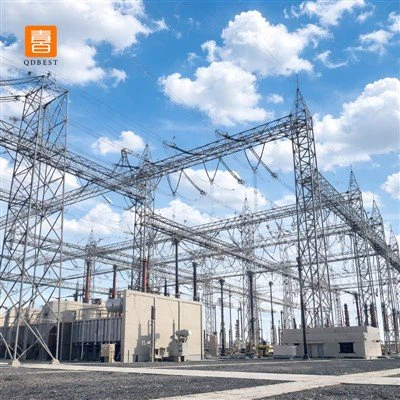
If you've ever driven down a highway and spotted those tall, skeletal steel towers holding up phone lines, you've probably wondered how they don't topple over when a strong gust hits. Let's break down the maximum wind speed these towers can endure, why it's not a one-size-fits-all number, and what goes into making sure yours stands tall.
First off, let's clear up a common myth: there's no single "max speed" for every telecom angle steel tower. A tower in a hurricane-prone area is going to be way sturdier than one in a place with mild, breezy summers. The key here is design standards, material quality, and how the tower's built to handle wind forces. That's where our products, like the Telecom Angle Steel Tower, come into play-we don't just sell a tower; we engineer it for specific environments.
Wind load calculation is the backbone of this whole process. It's not just about how fast the wind blows, but also factors like the shape of the tower, the area it presents to the wind, and the local wind maps from places like the American Society of Civil Engineers (ASCE) or international standards like ISO 16770. Lattice towers-think the Four-legged Lattice Tower we manufacture-are great here because their open design lets wind pass through, unlike a solid pole tower which catches more wind. That reduced wind load is why angle steel lattice towers are so popular for telecom; they balance height, strength, and wind resistance without being overly bulky.
Let's talk numbers to make this concrete. Most standard telecom angle steel towers we produce are designed to meet ASCE 7-16 wind load requirements, which cover up to 110 mph (177 km/h) for general locations. But wait-if you're in a coastal area where hurricanes hit, we can upgrade that. Our 60M Angle Steel Gsm Microwave Telecom Tower, for example, can be engineered to handle 130 mph (209 km/h) winds, which is the threshold for Category 3 hurricanes. That's because taller towers (60 meters is almost 200 feet) are more exposed to higher wind speeds at elevation, so they need extra reinforcement in their angle steel joints and base plates.


Shorter towers have their own wind challenges, too. Our 25M Galvanized Angle Steel Microwave Communication Tower is perfect for small towns or rural areas where height isn't the main priority. Even at 25 meters, we design it to handle 100 mph (161 km/h) winds as a standard, and if you're in a windy valley or near a mountain pass, we can tweak it to go up to 120 mph (193 km/h). Shorter towers are often more rigid, but their base is smaller, so we have to make sure the foundation-usually concrete anchors-is just as strong as the steel structure to prevent it from lifting or sliding.
Another product we're proud of is our 35M Telecom 4-Legged Galvanized Angular Steel Towers. The four-legged design isn't just for looks-it distributes wind force evenly across the tower's legs, which means it can handle higher speeds without putting too much stress on any one part. We've tested these towers in wind tunnels, and under ideal conditions, they can hold up to 140 mph (225 km/h) if you pair them with a reinforced foundation. That's overkill for most places, but if you're in a region that sees frequent severe thunderstorms, that extra strength gives you peace of mind.
Now, what actually happens when a tower is pushed beyond its max wind speed? It's not just a sudden collapse-usually, you'll see small signs first, like bent angle steel joints or loosened bolts. That's why regular maintenance is important. As a supplier, we don't just build the tower and disappear; we work with clients to do annual inspections, especially before storm season. We'll check for rust (even though all our towers are galvanized, rust can still form in high-moisture areas), tightness of bolts, and any signs of structural shift.
Wait, let's talk about galvanization for a second. All our telecom angle steel towers are hot-dip galvanized, which is a process where we coat the steel with zinc to prevent corrosion. Corrosion weakens the steel over time, so a corroded tower will have a lower wind resistance than a new one. That's why galvanization isn't just a "nice to have"-it's a critical part of making sure the tower can endure wind for 20+ years. Our 25M, 35M, and 60M towers all get this treatment, so they're built to last in rain, snow, and salty coastal air.
I should also mention that wind speed isn't the only environmental factor. Ice and snow add weight to the tower, which can combine with wind to create extra stress. For example, a 10-foot section of ice on a 60-meter tower can add several hundred pounds of weight, so our design takes that into account too. We use thicker angle steel for towers in snowy regions, and we'll adjust the wind load calculations to include ice accumulation data from your local area.
Let me share a real example: Last year, we worked with a client in Florida who needed a tower for a small town that had been hit by Hurricane Irma a few years prior. They'd lost their old pole tower in Irma, so they wanted something that could survive a Category 4 storm (which is up to 156 mph). We supplied them with a custom-engineered 45-meter four-legged angle steel tower-similar to our 35M but with extra bracing in the legs. It's tested to handle 155 mph winds, and they've told us it's withstood two tropical storms since installation with no issues. That's exactly why we do what we do: tailor our towers to the client's specific location and needs.
You might be wondering, "Can I just use a generic tower for my area?" The short answer is no. A tower that works in a flat, open field might not work in a city where buildings cause wind turbulence, or in a mountainous area where wind speeds are higher at peak elevations. That's why partnering with a supplier who does custom design-like us- is key. We don't just send you a catalog tower; we work with your team to get your location's wind data, plan the foundation, and adjust the tower's design to fit.
So, to wrap this up: the maximum wind speed a telecom angle steel tower can endure depends on three main things: 1) its design (four-legged lattice vs. other types, steel thickness, bracing), 2) the local environmental conditions (hurricane zone, snow/ice, turbulence), and 3) the quality of materials (galvanized steel vs. uncoated, bolt strength). Most standard towers we sell can handle 100-110 mph, but with upgrades, that can go up to 150+ mph for severe weather zones.
If you're in the market for a telecom angle steel tower, or you want to upgrade your current setup to handle stronger winds, don't hesitate to reach out. We've got decades of experience building towers for every type of environment, and we'll help you find the right product-whether it's a short 25M tower for a rural hotspot, a 60M tower for a coastal city, or a custom four-legged tower for a storm-prone area. Just get in touch with our team to start the conversation, and we'll walk you through every step.